Chapter 6.2
Provisions for the construction and testing of pressure receptacles, aerosol dispensers, small receptacles containing gas (gas cartridges) and fuel cell cartridges containing liquefied flammable gas
- Note:
- Aerosol dispensers, small receptacles containing gas (gas cartridges) and fuel cell cartridges containing liquefied flammable gas are not subject to the provisions of 6.2.1 to 6.2.3.
- 6.2.1
- General provisions
- 6.2.1.1
- Design and construction
- 6.2.1.1.1
- Pressure receptacles and their closures shall be designed, manufactured, tested and equipped in such a way as to withstand all conditions, including fatigue, to which they will be subjected during normal conditions of transport and intended use.
- 6.2.1.1.2
- In recognition of scientific and technological advances, and recognizing that pressure receptacles other than those that bear "UN" certification marks may be used on a national or regional basis, pressure receptacles conforming to requirements other than those specified in this Code may be used if approved by the competent authorities in the countries of transport and use.
- 6.2.1.1.3
- In no case shall the minimum wall thickness be less than that specified in the design and construction technical standards.
- 6.2.1.1.4
- For welded pressure receptacles, only metals of weldable quality shall be welded.
- 6.2.1.1.5
- The test pressure of pressure receptacle shells and bundles of cylinders shall be in accordance with packing instruction P200, or, for a chemical under pressure, with packing instruction P206. The test pressure for closed cryogenic receptacles shall be in accordance with packing instruction P203. The test pressure of a metal hydride storage system shall be in accordance with packing instruction P205. The test pressure of a cylinder shell for an adsorbed gas shall be in accordance with packing instruction P208.
- 6.2.1.1.6
- Cylinders or cylinder shells assembled in bundles shall be structurally supported and held together as a unit. Cylinders or cylinder shells shall be secured in a manner that prevents movement in relation to the structural assembly and movement that would result in the concentration of harmful local stresses. Manifold assemblies (e.g. manifold, valves, and pressure gauges) shall be designed and constructed such that they are protected from impact damage and forces normally encountered in transport. Manifolds shall have at least the same test pressure as the cylinders. For toxic liquefied gases, each cylinder shell shall have an isolation valve to ensure that each cylinder can be filled separately and that no interchange of cylinder contents can occur during transport.
- 6.2.1.1.7
- Contact between dissimilar metals which could result in damage by galvanic action shall be avoided.
- 6.2.1.1.8
-
The following additional provisions apply to the construction of closed cryogenic receptacles for refrigerated liquefied gases:
The mechanical properties of the metal used shall be established for each pressure receptacle, including the impact strength and the bending coefficient;
The pressure receptacles shall be thermally insulated. The thermal insulation shall be protected against impact by means of a jacket. If the space between the inner vessel and the jacket is evacuated of air (vacuum insulation), the jacket shall be designed to withstand, without permanent deformation, an external pressure of at least 100 kPa (1 bar) calculated in accordance with a recognized technical code or a calculated critical collapsing pressure of not less than 200 kPa (2 bar) gauge pressure. If the jacket is so closed as to be gas-tight (e.g. in the case of vacuum insulation), a device shall be provided to prevent any dangerous pressure from developing in the insulating layer in the event of inadequate gas-tightness of the inner vessel or its service equipment. The device shall prevent moisture from penetrating into the insulation.
Closed cryogenic receptacles intended for the transport of refrigerated liquefied gases having a boiling point below -182°C at atmospheric pressure shall not include materials which may react with oxygen or oxygen-enriched atmospheres in a dangerous manner, when located in parts of the thermal insulation where there is a risk of contact with oxygen or with oxygen-enriched liquid.
Closed cryogenic receptacles shall be designed and constructed with suitable lifting and securing arrangements.
- 6.2.1.1.9
-
Additional requirements for the construction of acetylene cylinders
Cylinder shells for UN 1001 acetylene, dissolved, and UN 3374 acetylene, solvent free, shall be filled with a porous material, uniformly distributed, of a type that conforms to the requirements and testing specified by a standard or technical code recognized by the competent authority and which:
is compatible with the cylinder shell and does not form harmful or dangerous compounds either with the acetylene or with the solvent in the case of UN 1001; and
is capable of preventing the spread of decomposition of the acetylene in the porous material.
In the case of UN 1001, the solvent shall be compatible with those parts of the cylinder that are in contact with it.
- 6.2.1.2
- Materials
- 6.2.1.2.1
- Construction materials of pressure receptacles and their closures which are in direct contact with dangerous goods shall not be affected or weakened by the dangerous goods intended to be transported and shall not cause a dangerous effect, e.g. catalysing a reaction or reacting with the dangerous goods.
- 6.2.1.2.2
- Pressure receptacles and their closures shall be made of the materials specified in the design and construction technical standards and the applicable packing instruction for the substances intended for transport in the pressure receptacle. The materials shall be resistant to brittle fracture and to stress corrosion cracking as indicated in the design and construction technical standards.
- 6.2.1.3
- Service equipment
- 6.2.1.3.1
- Service equipment subjected to pressure, "excluding porous, absorbent or adsorbent material, pressure relief devices, pressure gauges or indicators, shall be designed and constructed so that the burst pressure is at least 1.5 times the test pressure of the pressure receptacle.
- 6.2.1.3.2
- Service equipment shall be configured or designed to prevent damage and unintended opening that could result in the release of the pressure receptacle contents during normal conditions of handling and transport. All closures shall be protected in the same manner as is required for valves in 4.1.6.1.8. Manifold piping leading to shut-off valves shall be sufficiently flexible to protect the shut-off valves and the piping from shearing or releasing the pressure receptacle contents..
- 6.2.1.3.3
- Pressure receptacles which are not capable of being handled manually or rolled shall be fitted with handling devices (skids, rings, straps) ensuring that they can be safely handled by mechanical means and so arranged as not to impair the strength of, nor cause undue stresses in, the pressure receptacle.
- 6.2.1.3.4
- Individual pressure receptacles shall be equipped with pressure relief devices as specified in packing instruction P200(1), P205 or in 6.2.1.3.6.4 and 6.2.1.3.6.5. Pressure relief devices shall be designed to prevent the entry of foreign matter, the leakage of gas and the development of any dangerous excess pressure. When fitted, pressure relief devices on manifolded horizontal pressure receptacles filled with flammable gas shall be arranged to discharge freely to the open air in such a manner as to prevent any impingement of escaping gas upon the pressure receptacle itself under normal conditions of transport.
- 6.2.1.3.5
- Pressure receptacles where filling is measured by volume shall be provided with a level indicator.
- 6.2.1.3.6
- Additional provisions for closed cryogenic receptacles
- 6.2.1.3.6.1
- Each filling and discharge opening in a closed cryogenic receptacle used for the transport of flammable refrigerated liquefied gases shall be fitted with at least two mutually independent shut-off devices in series, the first being a stop-valve, the second being a cap or equivalent device.
- 6.2.1.3.6.2
- For sections of piping which can be closed at both ends and where liquid product can be trapped, a method of automatic pressure relief shall be provided to prevent excess pressure build-up within the piping.
- 6.2.1.3.6.3
- Each connection on a closed cryogenic receptacle shall be clearly marked to indicate its function (e.g., vapour or liquid phase).
- 6.2.1.3.6.4
- Pressure relief devices
- 6.2.1.3.6.4.1
- Each closed cryogenic receptacle shall be provided with at least one pressure relief device. The pressure relief device shall be of the type that will resist dynamic forces, including surge.
- 6.2.1.3.6.4.2
- Closed cryogenic receptacles may, in addition, have a frangible disc in parallel with the spring-loaded device(s) in order to meet the provisions of 6.2.1.3.6.5.
- 6.2.1.3.6.4.3
- Connections to pressure relief devices shall be of sufficient size to enable the required discharge to pass unrestricted to the pressure relief device.
- 6.2.1.3.6.4.4
- All pressure relief device inlets shall, under maximum filling conditions, be situated in the vapour space of the closed cryogenic receptacle and the devices shall be so arranged as to ensure that the escaping vapour is discharged unrestrictedly.
- 6.2.1.3.6.5
-
Capacity and setting of pressure relief devices
Note: In relation to pressure relief devices of closed cryogenic receptacles, "MAWP" means the maximum effective gauge pressure permissible at the top of a loaded closed cryogenic receptacle in its operating position, including the highest effective pressure during filling and discharge.
- 6.2.1.3.6.5.1
- The pressure relief device shall open automatically at a pressure not less than the MAWP and be fully open at a pressure equal to 110% of the MAWP. It shall, after discharge, close at a pressure not lower than 10% below the pressure at which discharge starts and shall remain closed at all lower pressures.
- 6.2.1.3.6.5.2
- Frangible discs shall be set to rupture at a nominal pressure which is the lower of either the test pressure or 150% of the MAWP.
- 6.2.1.3.6.5.3
- In the case of the loss of vacuum in a vacuum-insulated closed cryogenic receptacle, the combined capacity of all pressure relief devices installed shall be sufficient so that the pressure (including accumulation) inside the closed cryogenic receptacle does not exceed 120% of the MAWP.
- 6.2.1.3.6.5.4
- The required capacity of the pressure relief devices shall be calculated in accordance with an established technical code recognized by the competent authority.1
- 6.2.1.4
- Approval of pressure receptacles
- 6.2.1.4.1
- The conformity of pressure receptacles shall be assessed at time of manufacture as required by the competent authority. Pressure receptacles shall be inspected, tested and approved by an inspection body. The technical documentation shall include full specifications on design and construction, and full documentation on the manufacturing and testing.
- 6.2.1.4.2
- Quality assurance systems shall conform to the requirements of the competent authority.
- 6.2.1.4.3
- Pressure receptacle shells and the inner vessels of closed cryogenic receptacles shall be inspected, tested and approved by an inspection body."
- 6.2.1.4.4
-
For acetylene cylinders, conformity assessment shall comprise either:
- 6.2.1.5
- Initial inspection and test
- 6.2.1.5.1
-
New pressure receptacles, other than closed cryogenic receptacles, metal hydride storage systems and bundles of cylinders, shall be subjected to testing and inspection during and after manufacture in accordance with the applicable design standards or recognized technical codes including the following:
On an adequate sample of "pressure receptacle shells:
testing of the mechanical characteristics of the material of construction;
verification of the minimum wall thickness;
verification of the homogeneity of the material for each manufacturing batch;
inspection of the external and internal conditions of the pressure receptacles;
inspection of the threads used to fit closures;
verification of the conformance with the design standard;
For all all pressure receptacle shells:
a hydraulic pressure test. Pressure receptacle shells shall meet the acceptance criteria specified in the design and construction technical standard or technical code;
Note: With the agreement of the competent authority, the hydraulic pressure test may be replaced by a test using a gas, where such an operation does not entail any danger.
inspection and assessment of manufacturing defects and either repairing them or rendering the pressure receptacle shells unserviceable. In the case of welded pressure receptacle shells, particular attention shall be paid to the quality of the welds;
an inspection of the marks on the pressure receptacle shells;
in addition, cylinder shells intended for the transport of UN 1001 acetylene, dissolved and UN 3374 acetylene, solvent free shall be inspected to ensure proper installation and condition of the porous material and, if applicable, the quantity of solvent.
- 6.2.1.5.2
-
On an adequate sample of inner vessels:
testing of the mechanical characteristics of the material of construction;
verification of the conformance with the design standard or code; and
For all inner vessels:
On an adequate sample of closures:
On an adequate sample of completed closed cryogenic receptacles:
- 6.2.1.5.3
-
For metal hydride storage systems, it shall be verified that the inspections and tests specified in 6.2.1.5.1.1, .2, .3, .4, .5 if applicable, .6, .7, .8 and .9 have been performed on an adequate sample of the pressure receptacle shells used in the metal hydride storage system. In addition, on an adequate sample of metal hydride storage systems, the inspections and tests specified in 6.2.1.5.1.3 and .6 shall be performed, as well as 6.2.1.5.1.5, if applicable, and inspection of the external conditions of the metal hydride storage system.
Additionally, all metal hydride storage systems shall undergo the initial inspections and tests specified in 6.2.1.5.1.8 and .9, as well as a leakproofness test and a test of the satisfactory operation of the service equipment.
- 6.2.1.5.4
- 6.2.1.6
- Periodic inspection and test
- 6.2.1.6.1
-
Refillable pressure receptacles, other than cryogenic receptacles, shall be subjected to periodic inspections and tests, by a body authorized by the competent authority, in accordance with the following:
Check of the external conditions of the pressure receptacle and verification of the equipment and the external marks;
Check of the internal conditions of the pressure receptacle (e.g., internal inspection, verification of minimum wall thickness);
-
Note 1: With the agreement of the competent authority, the hydraulic pressure test may be replaced by a test using a gas, where such an operation does not entail any danger.
Note 2: With the agreement of the competent authority, the hydraulic pressure test of cylinder shells or tube shells may be replaced by an equivalent method based on acoustic emission testing or a combination of acoustic emission testing and ultrasonic examination. ISO 16148:2006 may be used as a guide for acoustic emission testing procedures.*
Note: For the periodic inspection and test frequencies, see packing instruction P200 or, for a chemical under pressure, packing instruction P206 of 4.1.4.1).
- 6.2.1.6.2
- Cylinders intended for the transport of UN 1001 acetylene, dissolved and UN 3374 acetylene, solvent free shall be examined only as specified in 6.2.1.6.1.1, 6.2.1.6.1.3 and 6.2.1.6.1.5. In addition, the condition of the porous material (e.g. cracks, top clearance, loosening, or settlement) shall be examined.
- 6.2.1.6.3
- Pressure relief valves for closed cryogenic receptacles shall be subject to periodic inspections and tests.
- 6.2.1.7
- Requirements for manufacturers
- 6.2.1.7.1
-
The manufacturer shall be technically able and shall possess all resources required for the satisfactory manufacture of pressure receptacles; this relates in particular to qualified personnel:
to supervise the entire manufacturing process;
to carry out joining of materials; and
to carry out the relevant tests.
- 6.2.1.7.2
- A proficiency test of the manufacturers of pressure receptacle shells and the inner vessels of closed cryogenic receptacle shall in all instances be carried out by an inspection body approved by the competent authority of the country of approval. Proficiency testing of manufacturers of closures shall be carried out if the competent authority requires it. This test shall be carried out either during design type approval or during production inspection and certification..
- 6.2.1.8
- Requirements for inspection bodies
- 6.2.1.8.1
- Inspection bodies shall be independent from manufacturing enterprises and competent to perform the tests, inspections and approvals required.
- 6.2.2
-
Provisions for UN pressure receptacles
In addition to the general requirements of 6.2.1, UN pressure receptacles shall comply with the provisions of this section, including the standards, as applicable. Manufacture of new pressure receptacles or service equipment according to any particular standard in 6.2.2.1 and 6.2.2.3 is not permitted after the date shown in the right hand column of the tables.
Note 1: With the agreement of the competent authority, more recently published versions of the standards, if available, may be used.
Note 2: UN pressure receptacles and service equipment constructed according to standards applicable at the date of manufacture may continue in use subject to the periodic inspection provisions of this Code.
- 6.2.2.1
- Design, construction and initial inspection and test
- 6.2.2.1.1
-
The following standards apply for the design, construction and initial inspection and test of refillable UN cylinder shells, except that inspection requirements related to the conformity assessment system and approval shall be in accordance with 6.2.2.5:
Reference Title Applicable for manufacture ISO 9809-1:1999 Gas cylinders - Refillable seamless steel gas cylinders - Design, construction and testing - Part 1: Quenched and tempered steel cylinders with tensile strength less than 1100 MPa.
Note: The note concerning the F factor in section 7.3 of this standard shall not be applied for UN cylinders.Until 31 December 2018 ISO 9809-1:2010 Gas cylinders - Refillable seamless steel gas cylinders - Design, construction and testing - Part 1: Quenched and tempered steel cylinders with tensile strength less than 1100 MPa Until 31 December 2026 ISO 9809-1:2019 Gas cylinders – Design, construction and testing of refillable seamless steel gas cylinders and tubes – Part 1:Quenched and tempered steel cylinders and tubes with tensile strength less than 1 100 MPa Until further notice ISO 9809-2:2000 Gas cylinders - Refillable seamless steel gas cylinders - Design, construction and testing - Part 2: Quenched and tempered steel cylinders with tensile strength greater than or equal to 1100 MPa Until 31 December 2018 ISO 9809-2:2010 Gas cylinders - Refillable seamless steel gas cylinders - Design, construction and testing - Part 2: Quenched and tempered steel cylinders with tensile strength greater than or equal to 1100 MPa Until 31 December 2026 ISO 9809-2:2019 Gas cylinders – Design, construction and testing of refillable seamless steel gas cylinders and tubes – Part 2: Quenched and tempered steel cylinders and tubes with tensile strength greater than or equal to 1 100 MPa Until further notice ISO 9809-3:2000 Gas cylinders - Refillable seamless steel gas cylinders - Design, construction and - testing - Part 3: Normalized steel cylinders Until 31 December 2018 ISO 9809-3:2010 Gas cylinders - Refillable seamless steel gas cylinders - Design, construction and testing - Part 3: Normalized steel cylinders Until 31 December 2026 ISO 9809-3:2019 Gas cylinders – Design, construction and testing of refillable seamless steel gas cylinders and tubes – Part 3: Normalized steel cylinders and tubes Until further notice ISO 9809-4:2014 Gas cylinders – Refillable seamless steel gas cylinders – Design, construction and testing – Part 4:Stainless steel cylinders with an Rm value of less than 1 100 MPa Until further notice ISO 7866:1999 Gas cylinders - Refillable seamless aluminium alloy gas cylinders - Design, construction and testing
Note: The note concerning the F factor in section 7.2 of this standard shall not be applied for UN cylinders.
Aluminium alloy 6351A-T6 or equivalent shall not be authorized.Until 31 December 2020 ISO 7866:2012 + Cor 1:2014 Gas cylinders – Refillable seamless aluminium alloy gas cylinders – Design, construction and testing
Note: Aluminium alloy 6351A or equivalent shall not be used.Until further notice ISO 4706:2008 Gas cylinders - Refillable welded steel cylinders - Test pressure 60 bar and below Until further notice ISO 18172-1:2007 Gas cylinders - Refillable welded stainless steel cylinders - Part 1: Test pressure 6 MPa and below Until further notice ISO 20703:2006 Gas cylinders - Refillable welded aluminium-alloy cylinders - Design, construction and testing Until further notice ISO 11118:1999 Gas cylinders – Non-refillable metallic gas cylinders – Specification and test methods Until 31 December 2020 ISO 11118:2015 Gas cylinders – Non-refillable metallic gas cylinders – Specification and test methods Until further notice ISO 11119-1:2002 Gas cylinders of composite construction - Specification and test methods - Part 1: Hoop wrapped composite gas cylinders Until 31 December 2020 ISO 11119-1:2012 Gas cylinders – Refillable composite gas cylinders and tubes – Design, construction and testing – Part 1: Hoop wrapped fibre reinforced composite notice gas cylinders and tubes up to 450 L Until further notice ISO 11119-2:2002 Gas cylinders of composite construction - Specification and test methods - Part 2: Fully wrapped fibre reinforced composite gas cylinders with load-sharing metal liners Until 31 December 2020 ISO 11119-2:2012 + Amd 1:2014 Gas cylinders – Refillable composite gas cylinders and tubes – Design, construction and testing – Part 2: Fully wrapped fibre reinforced composite gas cylinders and tubes up to 450 L with load-sharing metal line Until further notice ISO 11119-3:2002 Gas cylinders of composite construction - Specification and test methods - Part 3: Fully wrapped fibre reinforced composite gas cylinders with non-load-sharing metallic or non-metallic liners
Note: This standard shall not be used for linerless cylinders manufactured from two parts joined together.Until 31 December 2020 ISO 11119-3:2013 Gas cylinders – Refillable composite gas cylinders and tubes – Design, construction and testing – Part 3: Fully wrapped fibre reinforced composite gas cylinders and tubes up to 450 L with non-load-sharing metallic or non-metallic liners
Note: This standard shall not be used for linerless cylinders manufactured from two parts joined together.Until further notice ISO 11119-4:2016 Gas cylinders – Refillable composite gas cylinders – Design, construction and testing – Part 4: Fully wrapped fibre reinforced composite gas cylinders up to 150 L with load-sharing welded metallic liners Until further notice Note 1: In the above referenced standards, composite cylinder shells shall be designed for a design life of not less than 15 years.
Note 2: Composite cylinder shells with a design life longer than 15 years shall not be filled after 15 years from the date of manufacture, unless the design has successfully passed a service life test programme. The programme shall be part of the initial design type approval and shall specify inspections and tests to demonstrate that composite cylinder shells manufactured accordingly remain safe to the end of their design life. The service life test programme and the results shall be approved by the competent authority of the country of approval that is responsible for the initial approval of the cylinder design. The service life of a composite cylinder shell shall not be extended beyond its initial approved design life.
- 6.2.2.1.2
-
The following standards apply for the design, construction and initial inspection and test of UN tube shells, except that inspection requirements related to the conformity assessment system and approval shall be in accordance with 6.2.2.5:
Reference Title Applicable for manufacture ISO 11120:1999 Gas cylinders - Refillable seamless steel tubes for compressed gas transport, of water capacity between 150 L and 3000 L - Design, construction and testing Note: The note concerning the F factor in section 7.1 of this standard shall not be applied for UN tubes Until 31 December 2022 ISO 11120:2015 Gas cylinders – Refillable seamless steel tubes of water capacity between 150 L and 3000 L - Design, construction and testing Until further notice ISO 11119-1:2012 Gas cylinders – Refillable composite gas cylinders and tubes – Design, construction and testing – Part 1: Hoop wrapped fibre reinforced composite gas cylinders and tubes up to 450 L Until further notice ISO 11119-2:2012 + Amd 1:2014 Gas cylinders – Refillable composite gas cylinders and tubes – Design, construction and testing – Part 2: Fully wrapped fibre reinforced composite gas cylinders and tubes up to 450 L with load-sharing metal liners Until further notice ISO 11119-3:2013 Gas cylinders – Refillable composite gas cylinders and tubes – Design, construction and testing – Part 3: Fully wrapped fibre reinforced composite gas cylinders and tubes up to 450 L with non-load-sharing metallic or non-metallic liners
Note: This standard shall not be used for linerless tubes manufactured from two parts joined together.Until further notice ISO 11515: 2013 Gas cylinders – Refillable composite reinforced tubes of water capacity between 450 L and 3000 L – Design, construction and testing Until 31 December 2026 ISO 11515: 2013 + Amd 1:2018 Gas cylinders – Refillable composite reinforced tubes of water capacity between 450 l and 3000 l – Design, construction and testing Until further notice ISO 9809-1: 2019 Gas cylinders – Design, construction and testing of refillable seamless steel gas cylinders and tubes – Part 1: Quenched and tempered steel cylinders and tubes with tensile strength less than 1 100 MP | Until further notice ISO 9809-2: 2019 Gas cylinders – Design, construction and testing of refillable seamless steel gas cylinders and tubes – Part 2: Quenched and tempered steel cylinders and tubes with tensile strength greater than or equal to 1 100 MPa Until further notice ISO 9809-3: 2019 Gas cylinders – Design, construction and testing of refillable seamless steel gas cylinders and tubes – Part 3: Normalized steel cylinders and tubes Until further notice Note 1: In the above referenced standards composite tube shells shall be designed for a design life of not less than 15 years.
Note 2: Composite tube shells with a design life longer than 15 years shall not be filled after 15 years from the date of manufacture, unless the design has successfully passed a service life test programme. The programme shall be part of the initial design type approval and shall specify inspections and tests to demonstrate that composite tube shells manufactured accordingly remain safe to the end of their design life. The service life test programme and the results shall be approved by the competent authority of the country of approval that is responsible for the initial approval of the cylinder shell design. The service life of a composite tube shell shall not be extended beyond its initial approved design life.
- 6.2.2.1.3
-
The following standards apply for the design, construction and initial inspection and test of UN acetylene cylinders, except that inspection requirements related to the conformity assessment system and approval shall be in accordance with 6.2.2.5:
For the cylinder shell:
Reference Title Applicable for manufacture ISO 9809-1:1999 Gas cylinders - Refillable seamless steel gas cylinders - Design, construction and testing - Part 1: Quenched and tempered steel cylinders with tensile strength less than 1100 MPs Note: The note concerning the F factor in section 7.3 of this standard shall not be applied for UN cylinders. Until 31 December 2018 ISO 9809-1:2010 Gas cylinders - Refillable seamless steel gas cylinders - Design, construction and testing - Part 1: Quenched and tempered steel cylinders with tensile strength less than 1100 MPa Until 31 December 2026 ISO 9809-1:2019 Gas cylinders – Design, construction and testing of refillable seamless steel gas cylinders and tubes – Part 1: Quenched and tempered steel cylinders and tubes with tensile strength less than 1 100 MPa Until further notice ISO 9809-3:2000 Gas cylinders - Refillable seamless steel gas cylinders - Design, construction and testing - Part 3: Normalized steel cylinders Until 31 December 2018 ISO 9809-3:2010 Gas cylinders - Refillable seamless steel gas cylinders - Design, construction and testing - Part 3: Normalized steel cylinders Until 31 December 2026 ISO 9809-3:2019 Gas cylinders – Design, construction and testing of refillable seamless steel gas cylinders and tubes – Part 3:: Normalized steel cylinders and tubes Until further notice ISO 4706:2008 Gas cylinders – Refillable welded steel cylinders – Test pressure 60 bar and below Until further notice ISO 7866:2012 + Cor 1:2014 Gas cylinders – Refillable seamless aluminum alloy gas cylinders – Design, construction and testing
Note: Aluminum alloy 6351A or equivalent shall not be usedUntil further notice For the acetylene cylinder including the porous material:
Reference Title Applicable for manufacture ISO 3807-1:2000 Cylinders for acetylene - Basic requirements - Part 1: Cylinders without fusible plugs Until 31 December 2020 ISO 3807-2:2000 Cylinders for acetylene - Basic requirements - Part 2: Cylinders with fusible plugs Until 31 December 2020 ISO 3807-2:2013 Gas cylinders – Acetylene cylinders – Basic requirements and type testing Until further notice - 6.2.2.1.4
-
The following standard applies for the design, construction and initial inspection and test of UN closed cryogenic receptacles, except that inspection requirements related to the conformity assessment system and approval shall be in accordance with 6.2.2.5:
Reference Title Applicable for manufacture ISO 21029-1:2004 Cryogenic vessels - Transportable vacuum insulated vessels of not more than 1000 L volume - Part 1: Design, fabrication, inspection and tests Until 31 December 2026 ISO 21029-1:2018 Cryogenic vessels – Transportable vacuum insulated vessels of not more |Until further notice + Amd.1:2019 than 1 000 litres volume – Part 1: Design, fabrication, inspection and tests - 6.2.2.1.5
-
The following standard applies for the design, construction and initial inspection and test of UN metal hydride storage systems, except that inspection requirements related to the conformity assessment system and approval shall be in accordance with 6.2.2.5:
Reference Title Applicable for manufacture ISO 16111:2008 Transportable gas storage devices - Hydrogen absorbed in reversible metal hydride Until 31 December 2026 ISO 16111:2018 Transportable gas storage devices - Hydrogen absorbed in reversible metal hydride Until further notice - 6.2.2.1.6
-
The following standard applies for the design, construction and initial inspection and test of UN bundles of cylinders. Each cylinder in a UN bundle of cylinders shall be a UN cylinder or UN cylinder shell complying with the requirements of 6.2.2. The inspection requirements related to the conformity assessment system and approval for UN bundles of cylinders shall be in accordance with 6.2.2.5.
Reference Title Applicable for manufacture ISO 10961:2010 Gas cylinders - Cylinder bundles - Design, manufacture, testing and inspection Until 31 December 2026 ISO 10961:2019 Gas cylinders - Cylinder bundles - Design, manufacture, testing and inspection Until further notice - 6.2.2.1.7
-
The following standards apply for the design, construction and initial inspection and test of UN cylinders for adsorbed gases except that the inspection requirements related to the conformity assessment system and approval shall be in accordance with 6.2.2.5.
Reference Title Applicable for manufacture ISO 11513:2011 Gas cylinders - Refillable welded steel cylinders containing materials for sub-atmospheric gas packaging (excluding acetylene) - Design, construction, testing, use and periodic inspection Until 31 December 2026 ISO 11513:2019 Gas cylinders - Refillable welded steel cylinders containing materials for sub-atmospheric gas packaging (excluding acetylene) - Design, construction, testing, use and periodic inspection Until further notice ISO 9809-1:2010 Gas cylinders - Refillable seamless steel gas cylinders - Design, construction and testing - Part 1: Quenched and tempered steel cylinders with tensile strength less than 1100 MPa Until 31 December 2026 ISO 9809-1:2019 Gas cylinders – Design, construction and testing of refillable seamless steel gas cylinders and tubes – Part 1: Quenched and tempered steel cylinders and tubes with tensile strength less than 1 100 MPa Until further notice - 6.2.2.1.8
-
The following standards apply for the design, construction and initial inspection and test of UN pressure drums, except that inspection requirements related to the conformity assessment system and approval shall be in accordance with 6.2.2.5:
Reference Title Applicable for manufacture ISO 21172-1:2015 Gas cylinders – Welded steel pressure drums up to 3,000 L capacity for the transport of gases – Design and construction – Part 1: Capacities up to 1,000 L
Note: Irrespective of section 6.3.3.4 of this standard, welded steel gas pressure drums with dished ends convex to pressure may be used for the transport of corrosive substances provided all applicable requirements of this Code are met.Until 31 December 2026 ISO 21172-1:2015 + Amd.1:2018 Gas cylinders – Welded steel pressure drums up to 3 000 litres capacity for the transport of gases – Design and construction – Part 1: Capacities up to 1 000 litres Until further notice ISO 4706: 2008 Gas cylinders - Refillable welded steel cylinders – Test pressure 60 bar and below Until further notice ISO 18172-1:2007 Gas cylinders - Refillable welded stainless steel cylinders – Part 1: Test pressure 6 MPa and below Until further notice - 6.2.2.1.9
-
- 6.2.2.2
-
Materials
In addition to the material requirements specified in the pressure receptacle design and construction standards, and any restrictions specified in the applicable packing instruction for the gas(es) to be transported (e.g. packing instruction P200 or P205), the following standards apply to material compatibility:
ISO 11114-1:2012 + Amd 1:2017 Gas cylinders - Compatibility of cylinder and valve materials with gas contents - Part 1: Metallic materials ISO 11114-2:2013 Gas cylinders - Compatibility of cylinder and valve materials with gas contents - Part 2: Non-metallic materials - 6.2.2.3
-
Reference Title Applicable for manufacture ISO 11117:1998 Gas cylinders - Valve protection caps and valve guards for industrial and medical gas cylinders - Design, construction and tests Until 31 December 2014 ISO 11117:2008 + Cor 1:2009 Gas cylinders - Valve protection caps and valve guards - Design, construction and tests Until 31 December 2026 ISO 11117:2019 Gas cylinders - Valve protection caps and guards - Design, construction and tests Until further notice ISO 10297:1999 Gas cylinders - Refillable gas cylinder valves - Specification and type testing Until 31 December 2008 ISO 10297:2006 Gas cylinders - Refillable gas cylinder valves - Specification and type testing Until 31 December 2020 ISO 10297:2014 Gas cylinders – Cylinder valves – Specification and type testing Until 31 December 2022 ISO 10297:2014 + Amd 1:2017 Gas cylinders – Cylinder valves – Specification and type testing; Until further notice ISO 13340:2001 Transportable gas cylinders - Cylinder valves for non-refillable cylinders Specification and prototype testing Until 31 December 2020 ISO 14246:2014 Gas cylinders - Cylinder valves - Manufacturing tests and examination Until 31 December 2024 ISO 14246:2014 + Amd 1:2017 Gas cylinders - Cylinder valves - Manufacturing tests and examination Until further notice ISO 17871:2015 Gas cylinders - Quick release cylinders valves - Specification and type testing Note: This standard shall not be used for flammable gases. Until 31 December 2026 ISO 17871:2020 Gas cylinders - Quick release cylinders valves - Specification and type testing Until further notice ISO 17879:2017 Gas cylinders – Self-closing cylinder valves– Specification and type testing Note: This standard shall not be applied to self-closing valves in acetylene cylinders. Until further notice For UN metal hydride storage systems, the requirements specified in the following standard apply to closures and their protection:
Reference Title Applicable for manufacture ISO 16111:2008 Transportable gas storage devices - Hydrogen absorbed in reversible metal hydride Until 31 December 2026 ISO 16111:2018 Transportable gas storage devices - Hydrogen absorbed in reversible metal hydride Until further notice - 6.2.2.4
-
Periodic inspection and test
The following standards apply to periodic inspection and testing of UN pressure receptacles:
Reference Title Applicable for ISO 6406:2005 Seamless steel gas cylinders - Periodic inspection and testing Until 31 December 2024 ISO 18119:2018 Gas cylinders – Seamless steel and seamless aluminium-alloy gas cylinders and tubes – Periodic inspection and testing|Until further notice Until further notice ISO 10460:2005 Gas cylinders - Welded carbon-steel gas cylinders - Periodic inspection and testing Note: The repair of welds described in clause 12.1 of this standard shall not be permitted. Repairs described in clause 12.2 require the approval of the competent authority which approved the periodic inspection and test body in accordance with 6.2.2.6. Until 31 December 2024 ISO 10460:2018 Gas cylinders – Welded aluminium-alloy, carbon and stainless steel gas cylinders – Periodic inspection and testing. Until further notice ISO 10461:2005/ Amd1:2006 Seamless aluminium-alloy gas cylinders - Periodic inspection and testing Until 31 December 2024 ISO 10462:2013 Gas cylinders – Acetylene cylinders – Periodic inspection and maintenance Until 31 December 2024 ISO 10462:2013 + Amd1:2019 Gas cylinders – Acetylene cylinders –Periodic inspection and maintenance Until further notice ISO 11513:2011 Gas cylinders - Refillable welded steel cylinders containing materials for sub-atmospheric gas packaging (excluding acetylene) - Design, construction, testing, use and periodic inspection Until 31 December 2024 ISO 11513:2019 Gas cylinders – Refillable welded steel cylinders containing materials for sub-atmospheric gas packaging (excluding acetylene) – Design, construction, testing, use and periodic inspection Until further notice ISO 11623:2002 Transportable gas cylinders - Periodic inspection and testing of composite gas cylinders Until 31 December 2010 ISO 11623:2015 Gas cylinders – Composite construction – Periodic inspection and testing Until further notice ISO 10460:2005 Gas cylinders - Welded carbon-steel gas cylinders - Periodic inspection and testing
Note: The repair of welds described in clause 12.1 of this standard shall not be permitted. Repairs described in clause 12.2 require the approval of the competent authority which approved the periodic inspection and test body in accordance with 6.2.2.6.Until further notice ISO 22434:2006 Transportable gas cylinders – Inspection and maintenance of cylinder valves
Note: These requirements may be met at times other than at the periodic inspection and test of UN cylinders.Until further notice ISO 20475:2018 Gas cylinders – Cylinder bundles – Periodic inspection and testing Until further notice ISO 23088:2020 Gas cylinders – Periodic inspection and testing of welded steel pressure drums – Capacities up to 1 000L. Until further notice The following standard applies to the periodic inspection and testing of UN metal hydride storage systems:
Reference Title Applicable for ISO 16111:2008 Transportable gas storage devices - Hydrogen absorbed in reversible metal hydride Until 31 December 2024 ISO 16111:2018 Transportable gas storage devices - Hydrogen absorbed in reversible metal hydride Until further notice - 6.2.2.5
- Conformity assessment system and approval for manufacture of pressure receptacles
- 6.2.2.5.0
-
Definitions
For the purposes of this section:
Conformity assessment system means a system for competent authority approval of a manufacturer, by pressure receptacle design type approval, approval of manufacturer's quality system and approval of inspection bodies;
Design type means a pressure receptacle design as specified by a particular pressure receptacle standard;
Verify means confirm by examination or provision of objective evidence that specified requirements have been fulfilled.
- 6.2.2.5.1
-
- 6.2.2.5.2
-
General requirements
Competent authority
- 6.2.2.5.2.1
-
The competent authority that approves the pressure receptacle shall approve the conformity assessment system for the purpose of ensuring that pressure receptacles conform to the provisions of this Code. In instances where the competent authority that approves a pressure receptacle is not the competent authority in the country of manufacture, the marks of the approval country and the country of manufacture shall be indicated in the pressure receptacle marking (see 6.2.2.7 and 6.2.2.8).
The competent authority of the country of approval shall supply, upon request, evidence demonstrating compliance of this conformity assessment system to its counterpart in a country of use.
- 6.2.2.5.2.2
- The competent authority may delegate its functions in this conformity assessment system in whole or in part.
- 6.2.2.5.2.3
-
The competent authority shall ensure that a current list of approved inspection bodies and their identity marks and approved manufacturers and their identity marks is available.
Inspection body
- 6.2.2.5.2.4
-
The inspection body shall be approved by the competent authority for the inspection of pressure receptacles and shall:
have a staff with an organizational structure, capable, trained, competent, and skilled, to satisfactorily perform its technical functions;
have access to suitable and adequate facilities and equipment;
operate in an impartial manner and be free from any influence which could prevent it from doing so;
ensure commercial confidentiality of the commercial and proprietary activities of the manufacturer and other bodies;
maintain clear demarcation between actual inspection body functions and unrelated functions;
operate a documented quality system;
ensure that the tests and inspections specified in the relevant pressure receptacle standard and in this Code are performed; and
maintain an effective and appropriate report and record system in accordance with 6.2.2.5.6.
- 6.2.2.5.2.5
-
The inspection body shall perform design type approval, pressure receptacle production testing and inspection, and certification to verify conformity with the relevant pressure receptacle standard (see 6.2.2.5.4 and 6.2.2.5.5).
Manufacturer
- 6.2.2.5.2.6
-
The manufacturer shall:
operate a documented quality system in accordance with 6.2.2.5.3;
apply for design type approvals in accordance with 6.2.2.5.4;
select an inspection body from the list of approved inspection bodies maintained by the competent authority in the country of approval; and
maintain records in accordance with 6.2.2.5.6.
Testing laboratory
- 6.2.2.5.2.7
-
The testing laboratory shall have:
staff with an organizational structure, sufficient in number, competence and skill; and
suitable and adequate facilities and equipment to perform the tests required by the manufacturing standard to the satisfaction of the inspection body.
- 6.2.2.5.3
- Manufacturer's quality system
- 6.2.2.5.3.1
-
The quality system shall contain all the elements, requirements and provisions adopted by the manufacturer. It shall be documented in a systematic and orderly manner in the form of written policies, procedures and instructions.
The contents shall in particular include adequate descriptions of:
the organizational structure and responsibilities of personnel with regard to design and product quality;
the design control and design verification techniques, processes, and procedures that will be used when designing the pressure receptacles;
the relevant pressure receptacle manufacturing, quality control, quality assurance and process operation instructions that will be used;
quality records, such as inspection reports, test data and calibration data;
management reviews to ensure the effective operation of the quality system arising from the audits in accordance with 6.2.2.5.3.2;
the process describing how customer requirements are met;
the process for control of documents and their revision;
the means for control of non-conforming pressure receptacles, purchased components, in-process and final materials; and
training programmes and qualification procedures for relevant personnel.
- 6.2.2.5.3.2
-
Audit of the quality system
The quality system shall be initially assessed to determine whether it meets the requirements in 6.2.2.5.3.1 to the satisfaction of the competent authority.
The manufacturer shall be notified of the results of the audit. The notification shall contain the conclusions of the audit and any corrective actions required.
Periodic audits shall be carried out, to the satisfaction of the competent authority, to ensure that the manufacturer maintains and applies the quality system. Reports of the periodic audits shall be provided to the manufacturer.
- 6.2.2.5.3.3
-
Maintenance of the quality system
The manufacturer shall maintain the quality system as approved in order that it remains adequate and efficient.
The manufacturer shall notify the competent authority that approved the quality system of any intended changes. The proposed changes shall be evaluated in order to determine whether the amended quality system will still satisfy the requirements in 6.2.2.5.3.1.
- 6.2.2.5.4
-
Approval process
Initial design type approval
- 6.2.2.5.4.1
- The initial design type approval shall consist of approval of the manufacturer's quality system and approval of the pressure receptacle design to be produced. An application for an initial design type approval shall meet the requirements of 6.2.2.5.3, 6.2.2.5.4.2 to 6.2.2.5.4.6 and 6.2.2.5.4.9.
- 6.2.2.5.4.2
- A manufacturer desiring to produce pressure receptacles in accordance with a pressure receptacle standard and this Code shall apply for, obtain, and retain a Design Type Approval Certificate issued by the competent authority in the country of approval for at least one pressure receptacle design type in accordance with the procedure given in 6.2.2.5.4.9. This certificate shall, on request, be submitted to the competent authority of the country of use.
- 6.2.2.5.4.3
-
An application shall be made for each manufacturing facility and shall include:
the name and registered address of the manufacturer and in addition, if the application is submitted by an authorized representative, its name and address;
the address of the manufacturing facility (if different from the above);
the name and title of the person(s) responsible for the quality system;
the designation of the pressure receptacle and the relevant pressure receptacle standard;
details of any refusal of approval of a similar application by any other competent authority;
the identity of the inspection body for design type approval;
documentation on the manufacturing facility as specified under 6.2.2.5.3.1; and
the technical documentation required for design type approval, which shall enable verification of the conformity of the pressure receptacles with the requirements of the relevant pressure receptacle design standard. The technical documentation shall cover the design and method of manufacture and shall contain, as far as is relevant for assessment, at least the following:
pressure receptacle design standard, design and manufacturing drawings, showing components and sub-assemblies, if any;
descriptions and explanations necessary for the understanding of the drawings and intended use of the pressure receptacles;
a list of the standards necessary to fully define the manufacturing process;
design calculations and material specifications; and
design type approval test reports, describing the results of examinations and tests carried out in accordance with 6.2.2.5.4.9.
- 6.2.2.5.4.4
- An initial audit in accordance with 6.2.2.5.3.2 shall be performed to the satisfaction of the competent authority.
- 6.2.2.5.4.5
- If the manufacturer is denied approval, the competent authority shall provide written detailed reasons for such denial.
- 6.2.2.5.4.6
-
Following approval, changes to the information submitted under 6.2.2.5.4.3 relating to the initial approval shall be provided to the competent authority.
Subsequent design type approvals
- 6.2.2.5.4.7
- An application for a subsequent design type approval shall encompass the requirements of 6.2.2.5.4.8 and 6.2.2.5.4.9, provided a manufacturer is in the possession of an initial design type approval. In such a case, the manufacturer's quality system according to 6.2.2.5.3 shall have been approved during the initial design type approval and shall be applicable for the new design.
- 6.2.2.5.4.8
-
The application shall include:
the name and address of the manufacturer and in addition, if the application is submitted by an authorized representative, its name and address;
details of any refusal of approval of a similar application by any other competent authority;
evidence that initial design type approval has been granted; and
the technical documentation, as described in 6.2.2.5.4.3.8.
Procedure for design type approval
- 6.2.2.5.4.9
-
The inspection body shall:
examine the technical documentation to verify that:
the design is in accordance with the relevant provisions of the standard, and
the prototype lot has been manufactured in conformity with the technical documentation and is representative of the design;
verify that the production inspections have been carried out as required in accordance with 6.2.2.5.5;
perform or have performed the examinations and tests specified in the pressure receptacle standard to determine that:
the standard has been applied and fulfilled, and
the procedures adopted by the manufacturer meet the requirements of the standard; and
ensure that the various type approval examinations and tests are correctly and competently carried out.
After prototype testing has been carried out with satisfactory results and all applicable requirements of 6.2.2.5.4 have been satisfied, a Design Type Approval Certificate shall be issued which shall include the name and address of the manufacturer, results and conclusions of the examination, and the necessary data for identification of the design type. If it was not possible to evaluate exhaustively the compatibility of the materials of construction with the contents of the pressure receptacle when the certificate was issued, a statement that compatibility assessment was not completed shall be included in the design type approval certificate.
If the manufacturer is denied a design type approval, the competent authority shall provide written detailed reasons for such denial.
- 6.2.2.5.4.10
-
Modifications to approved design types
The manufacturer shall either:
inform the issuing competent authority of modifications to the approved design type, where such modifications do not constitute a new design, as specified in the pressure receptacle standard; or
request a subsequent design type approval where such modifications constitute a new design according to the relevant pressure receptacle standard. This additional approval shall be given in the form of an amendment to the original design type approval certificate.
- 6.2.2.5.4.11
- Upon request, the competent authority shall communicate to any other competent authority information concerning design type approval, modifications of approvals, and withdrawn approvals.
- 6.2.2.5.5
-
Production inspection and certification
An inspection body, or its delegate, shall carry out the inspection and certification of each pressure receptacle. The inspection body selected by the manufacturer for inspection and testing during production may be different from the inspection body used for the design type approval testing.
Where it can be demonstrated to the satisfaction of the inspection body that the manufacturer has trained and competent inspectors, independent of the manufacturing operations, inspection may be performed by those inspectors. In such a case, the manufacturer shall maintain training records of the inspectors.
The inspection body shall verify that the inspections by the manufacturer and tests performed on those pressure receptacles fully conform to the standard and the provisions of this Code. Should non-conformance in conjunction with this inspection and testing be determined, the permission to have inspection performed by the manufacturer's inspectors may be withdrawn.
The manufacturer shall, after approval by the inspection body, make a declaration of conformity with the certified design type. The application of the pressure receptacle certification marks shall be considered a declaration that the pressure receptacle complies with the applicable pressure receptacle standards and the requirements of this conformity assessment system and with the provisions of this Code. The inspection body shall affix or delegate the manufacturer to affix the pressure receptacle certification marks and the registered mark of the inspection body to each approved pressure receptacle.
A certificate of compliance, signed by the inspection body and the manufacturer, shall be issued before the pressure receptacles are filled.
- 6.2.2.5.6
-
Records
Design type approval and certificate of compliance records shall be retained by the manufacturer and the inspection body for not less than 20 years.
- 6.2.2.6
- Approval system for periodic inspection and testing of pressure receptacles
- 6.2.2.6.1
-
Definitions
For the purposes of this section:
Approval system means a system for competent authority approval of a body performing periodic inspection and testing of pressure receptacles (hereinafter referred to as "periodic inspection and testing body"), including approval of that body's quality system.
- 6.2.2.6.2
-
General provisions
Competent authority
- 6.2.2.6.2.1
- The competent authority shall establish an approval system for the purpose of ensuring that the periodic inspection and testing of pressure receptacles conform to the provisions of this Code. In instances where the competent authority that approves a body performing periodic inspection and testing of a pressure receptacle is not the competent authority of the country approving the manufacture of the pressure receptacle, the marks of the approval country of periodic inspection and testing shall be indicated in the pressure receptacle mark (see 6.2.2.7). The competent authority of the country of approval for the periodic inspection and testing shall supply, upon request, evidence demonstrating compliance with this approval system, including the records of the periodic inspection and testing, to its counterpart in a country of use. The competent authority of the country of approval may terminate the Approval Certificate referred to in 6.2.2.6.4.1, upon evidence demonstrating non-compliance with the approval system.
- 6.2.2.6.2.2
- The competent authority may delegate its functions in this approval system, in whole or in part.
- 6.2.2.6.2.3
-
The competent authority shall ensure that a current list of approved periodic inspection and testing bodies and their identity marks is available.
Periodic inspection and testing body
- 6.2.2.6.2.4
-
The periodic inspection and testing body shall be approved by the competent authority and shall:
have a staff with an organizational structure, capable, trained, competent, and skilled, to perform its technical functions satisfactorily;
have access to suitable and adequate facilities and equipment;
operate in an impartial manner and be free from any influence which could prevent it from doing so;
ensure commercial confidentiality;
maintain clear demarcation between actual periodic inspection and testing body functions and unrelated functions;
operate a documented quality system in accordance with 6.2.2.6.3;
apply for approval in accordance with 6.2.2.6.4;
ensure that the periodic inspections and tests are performed in accordance with 6.2.2.6.5; and
maintain an effective and appropriate report and record system in accordance with 6.2.2.6.6.
- 6.2.2.6.3
- Quality system and audit of the periodic inspection and testing body
- 6.2.2.6.3.1
-
Quality system. The quality system shall contain all the elements, requirements and provisions adopted by the periodic inspection and testing body. It shall be documented in a systematic and orderly manner in the form of written policies, procedures and instructions. The quality system shall include:
a description of the organizational structure and responsibilities;
the relevant inspection and test, quality control, quality assurance, and process operation instructions that will be used;
quality records, such as inspection reports, test data, calibration data and certificates;
management reviews to ensure the effective operation of the quality system arising from the audits performed in accordance with 6.2.2.6.3.2;
a process for control of documents and their revision;
a means for control of non-conforming pressure receptacles; and
training programmes and qualification procedures for relevant personnel.
- 6.2.2.6.3.2
- Audit. The periodic inspection and testing body and its quality system shall be audited in order to determine whether it meets the requirements of this Code to the satisfaction of the competent authority. An audit shall be conducted as part of the initial approval process (see 6.2.2.6.4.3). An audit may be required as part of the process to modify an approval (see 6.2.2.6.4.6). Periodic audits shall be conducted, to the satisfaction of the competent authority, to ensure that the periodic inspection and testing body continues to meet the provisions of this Code. The periodic inspection and testing body shall be notified of the results of any audit. The notification shall contain the conclusions of the audit and any corrective actions required.
- 6.2.2.6.3.3
- Maintenance of the quality system. The periodic inspection and testing body shall maintain the quality system as approved in order that it remains adequate and efficient. The periodic inspection and testing body shall notify the competent authority that approved the quality system of any intended changes, in accordance with the process for modification of an approval in 6.2.2.6.4.6.
- 6.2.2.6.4
-
Approval process for periodic inspection and testing bodies
Initial approval
- 6.2.2.6.4.1
- A body desiring to perform periodic inspection and testing of pressure receptacles in accordance with a pressure receptacle standard and with this Code shall apply for, obtain, and retain an Approval Certificate issued by the competent authority. This written approval shall, on request, be submitted to the competent authority of a country of use.
- 6.2.2.6.4.2
-
An application shall be made for each periodic inspection and testing body and shall include:
the name and address of the periodic inspection and testing body and, if the application is submitted by an authorized representative, its name and address;
the address of each facility performing periodic inspection and testing;
the name and title of the person(s) responsible for the quality system;
the designation of the pressure receptacles, the periodic inspection and test methods, and the relevant pressure receptacle standards met by the quality system;
documentation on each facility, the equipment, and the quality system as specified under 6.2.2.6.3.1;
the qualifications and training records of the periodic inspection and test personnel; and
details of any refusal of approval of a similar application by any other competent authority.
- 6.2.2.6.4.3
-
The competent authority shall:
examine the documentation to verify that the procedures are in accordance with the requirements of the relevant pressure receptacle standards and of this Code; and
conduct an audit in accordance with 6.2.2.6.3.2 to verify that the inspections and tests are carried out as required by the relevant pressure receptacle standards and by this Code, to the satisfaction of the competent authority.
- 6.2.2.6.4.4
- After the audit has been carried out with satisfactory results and all applicable requirements of 6.2.2.6.4 have been satisfied, an Approval Certificate shall be issued. It shall include the name of the periodic inspection and testing body, the registered mark, the address of each facility, and the necessary data for identification of its approved activities (e.g. designation of pressure receptacles, periodic inspection and test method and pressure receptacle standards).
- 6.2.2.6.4.5
-
If the periodic inspection and testing body is denied approval, the competent authority shall provide written detailed reasons for such denial.
Modifications to periodic inspection and testing body approvals
- 6.2.2.6.4.6
- Following approval, the periodic inspection and testing body shall notify the issuing competent authority of any modifications to the information submitted under 6.2.2.6.4.2 relating to the initial approval. The modifications shall be evaluated in order to determine whether the requirements of the relevant pressure receptacle standards and of this Code will be satisfied. An audit in accordance with 6.2.2.6.3.2 may be required. The competent authority shall accept or reject these modifications in writing, and an amended Approval Certificate shall be issued as necessary.
- 6.2.2.6.4.7
- Upon request, the competent authority shall communicate to any other competent authority, information concerning initial approvals, modifications of approvals, and withdrawn approvals.
- 6.2.2.6.5
-
Periodic inspection and test and certification
The application of the periodic inspection and test marks to a pressure receptacle shall be considered a declaration that the pressure receptacle complies with the applicable pressure receptacle standards and with the provisions of this Code. The periodic inspection and testing body shall affix the periodic inspection and test marks, including its registered mark, to each approved pressure receptacle (see 6.2.2.7.7). A record certifying that a pressure receptacle has passed the periodic inspection and test shall be issued by the periodic inspection and testing body, before the pressure receptacle is filled.
- 6.2.2.6.6
-
Records
The periodic inspection and testing body shall retain records of pressure receptacle periodic inspection and tests (both passed and failed), including the location of the test facility, for not less than 15 years. The owner of the pressure receptacle shall retain an identical record until the next periodic inspection and test unless the pressure receptacle is permanently removed from service.
- 6.2.2.7
-
Marking of refillable UN pressure receptacles
Note: Marking requirements for UN metal hydride storage systems are given in 6.2.2.9 , marking requirements for UN bundles of cylinders are given in 6.2.2.10 and marking requirements for closures are given in 6.2.2.11.
- 6.2.2.7.1
- Refillable UN pressure receptacle shells and closed cryogenic receptacles shall be marked clearly and legibly with certification, operational and manufacturing marks. These marks shall be permanently affixed (e.g. stamped, engraved, or etched) on the pressure receptacle. The marks shall be on the shoulder, top end or neck of the pressure receptacle shell or on a permanently affixed component of the pressure receptacle (e.g. welded collar or corrosion-resistant plate welded on the outer jacket of a closed cryogenic receptacle). Except for the UN packaging symbol, the minimum size of the marks shall be 5mm for pressure receptacles with a diameter greater than or equal to 140 mm and 2.5 mm for pressure receptacles with a diameter less than 140 mm. The minimum size of the UN packaging symbol shall be 10 mm for pressure receptacles with a diameter greater than or equal to 140 mm and 5 mm for pressure receptacles with a diameter less than 140 mm.
- 6.2.2.7.2
-
The following certification marks shall be applied:
The UN packaging symbol:

This symbol shall not be used for any purpose other than certifying that a packaging, a flexible bulk container, a portable tank or a MEGC complies with the relevant requirements in chapters 6.1, 6.2, 6.3, 6.5, 6.6, 6.7 or 6.9.
The technical standard (e.g. ISO 9809-1) used for design, construction and testing.
The character(s) identifying the country of approval as indicated by the distinguishing sign used on vehicles in international road traffic 2.
The identity mark or stamp of the inspection body that is registered with the competent authority of the country authorizing the marking.
Note: For the purpose of this mark the country of approval means the country of the competent authority that authorized the initial inspection and test of the individual receptacle at the time of manufacture.
The date of the initial inspection, the year (four digits) followed by the month (two digits) separated by a slash (i.e. "/").
Note: For acetylene cylinders the standard ISO 3807 shall also be marked.
- 6.2.2.7.3
-
The following operational marks shall be applied:
The test pressure in bar, preceded by the letters "PH" and followed by the letters "BAR";
The mass of the empty pressure receptacle including all permanently attached integral parts (e.g. neck ring, foot ring, etc.) in kilograms, followed by the letters "KG". This mass shall not include the mass of closure(s), valve protection cap or valve guard, any coating, or porous mass for acetylene. The mass shall be expressed to three significant figures rounded up to the last digit. For cylinders of less than 1 kg, the mass shall be expressed to two significant figures rounded up to the last digit. In the case of pressure receptacles for UN 1001 acetylene, dissolved and UN 3374 acetylene, solvent free, at least one decimal shall be shown after the decimal point and two digits for pressure receptacles of less than 1 kg.
The minimum guaranteed wall thickness of the pressure receptacle in millimetres followed by the letters "MM". This mark is not required for pressure receptacles with a water capacity less than or equal to 1 litre or for composite cylinders or for closed cryogenic receptacles.
In the case of pressure receptacles for compressed gases, UN 1001 acetylene, dissolved, and UN 3374 acetylene, solvent free, the working pressure in bar, preceded by the letters "PW". In the case of closed cryogenic receptacles, the maximum allowable working pressure preceded by the letters "MAWP".
In the case of pressure receptacles for liquefied gases, refrigerated liquefied gases and dissolved gases, the water capacity in litres expressed to three significant figures rounded down to the last digit, followed by the letter "L". If the value of the minimum or nominal water capacity is an integer, the digits after the decimal point may be neglected.
In the case of cylinders for UN 1001 acetylene, dissolved:
-the identity of the porous material (e.g. name or trademark); and
-the total mass of the filled acetylene cylinder in kilograms followed by the letters "KG"
- 6.2.2.7.4
-
The following manufacturing marks shall be applied:
Identification of the cylinder thread (e.g. 25E). This mark is not required for closed cryogenic receptacles.
Note: Information on marks that may be used for identifying threads for cylinders is given in ISO/TR 11364, Gas cylinders – Compilation of national and international valve stem/gas cylinder neck threads and their identification and marking system.
The manufacturer's mark registered by the competent authority. When the country of manufacture as indicated by is not the same as the country of approval, then the manufacturer's mark shall be preceded by the character(s) identifying the country of manufacture as the distinguishing sign used on vehicles in international road traffic2. The country mark and the manufacturer's mark shall be separated by a space or slash.
The serial number assigned by the manufacturer.
In the case of steel pressure receptacles and composite pressure receptacles with steel liner intended for the transport of gases with a risk of hydrogen embrittlement, the letter "H" showing compatibility of the steel (see ISO 11114-1:2012).
For composite cylinders and tubes having a limited design life, the letters “FINAL” followed by the design life shown as the year (four digits) followed by the month (two digits) separated by a slash (i.e. “/”).
For composite cylinders and tubes having a limited design life greater than 15 years and for composite cylinders and tubes having non-limited design life, the letters “SERVICE” followed by the date 15 years from the date of manufacture (initial inspection) shown as the year (four digits) followed by the month (two digits) separated by a slash (i.e. “/”).
Note: Once the initial design type has passed the service life test programme requirements in accordance with 6.2.2.1.1 Note 2 or 6.2.2.1.2 Note 2, future production no longer requires this initial service life mark. The initial service life mark shall be made unreadable on cylinders and tubes of a design type that has met the service life test programme requirements.
- 6.2.2.7.5
-
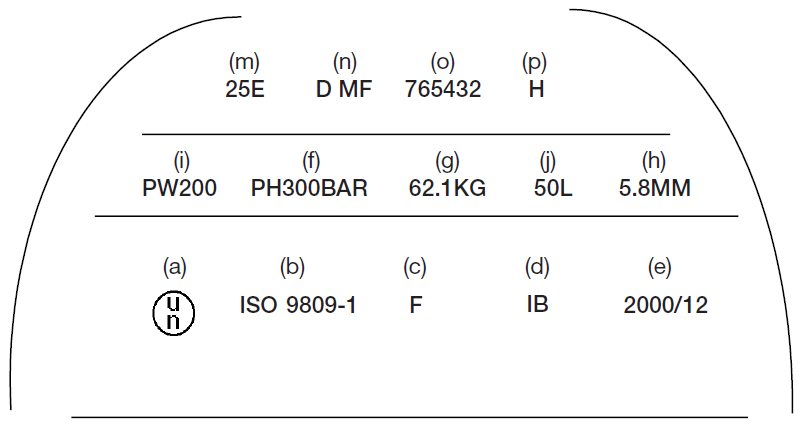
The above marks shall be placed in three groups.
Manufacturing marks shall be the top grouping and shall appear consecutively in the sequence given in 6.2.2.7.4 except for the marks described in 6.2.2.7.4 (q) and (r) which shall be adjacent to the periodic inspection and test marks of 6.2.2.7.7.
The operational marks in 6.2.2.7.3 shall be the middle grouping and the test pressure (f) shall be immediately preceded by the working pressure (i) when the latter is required.
Certification marks shall be the bottom grouping and shall appear in the sequence given in 6.2.2.7.2.
The following is an example of marking a cylinder.
- 6.2.2.7.6
- Other marks are allowed in areas other than the side wall, provided they are made in low-stress areas and are not of a size and depth that will create harmful stress concentrations. In the case of closed cryogenic receptacles, such marks may be on a separate plate attached to the outer jacket. Such marks shall not conflict with required marks.
- 6.2.2.7.7
-
In addition to the preceding marks, each refillable pressure receptacle that meets the periodic and test requirements of 6.2.2.4 shall be marked in sequence as follows:
the character(s) identifying the country authorizing the body performing the periodic inspection and test, as indicated by the distinguishing sign of motor vehicles in international road traffic2. This mark is not required if this body is approved by the competent authority of the country approving manufacture;
the registered mark of the body authorized by the competent authority for performing periodic inspection and test;
the date of the periodic inspection and test, the year (two digits) followed by the month (two digits) separated by a slash (i.e. "/"). Four digits may be used to indicate the year.
- 6.2.2.7.8
- The marks in accordance with 6.2.2.7.7 may be engraved on a metallic ring affixed to the cylinder or pressure drum when the valve is installed, and which is removable only by disconnecting the valve from the cylinder or pressure drum.
- 6.2.2.8
- Marking of non-refillable UN cylinders
- 6.2.2.8.1
- Non-refillable UN cylinders shall be marked clearly and legibly with certification and gas or cylinder specific marks. These marks shall be permanently affixed (e.g. stencilled, stamped, engraved, or etched) on the cylinder. Except when stencilled, the marks shall be on the shoulder, top end or neck of the cylinder shell or on a permanently affixed component of the cylinder (e.g. welded collar). Except for the "UN" mark and the "DO NOT REFILL" mark, the minimum size of the marks shall be 5mm for cylinders with a diameter greater than or equal to 140 mm and 2.5 mm for cylinders with a diameter less than 140 mm. The minimum size of the "UN" mark shall be 10mm for cylinders with a diameter greater than or equal to 140 mm and 5mm for cylinders with a diameter less than 140 mm. The minimum size of the "DO NOT REFILL" mark shall be 5 mm.
- 6.2.2.8.2
- The marks listed in 6.2.2.7.2 to 6.2.2.7.4 shall be applied with the exception of (g), (h) and (m). The serial number (o) may be replaced by the batch number. In addition, the words "DO NOT REFILL" in letters of at least 5 mm in height are required.
- 6.2.2.8.3
-
The requirements of 6.2.2.7.5 shall apply.
Note: Non-refillable cylinders may, on account of their size, substitute a label for these permanent marks.
- 6.2.2.8.4
- Other marks are allowed provided they are made in low-stress areas other than the side wall and are not of a size and depth that will create harmful stress concentrations. Such marks shall not conflict with required marks.
- 6.2.2.9
- Marking of UN metal hydride storage systems
- 6.2.2.9.1
- UN metal hydride storage systems shall be marked clearly and legibly with the marks listed below. These marks shall be permanently affixed (e.g. stamped, engraved, or etched) on the metal hydride storage system. The marks shall be on the shoulder, top end or neck of the metal hydride storage system or on a permanently affixed component of the metal hydride storage system. Except for the United Nations packaging symbol, the minimum size of the marks shall be 5 mm for metal hydride storage systems with a smallest overall dimension greater than or equal to 140 mm and 2.5 mm for metal hydride storage systems with a smallest overall dimension less than 140 mm. The minimum size of the United Nations packaging symbol shall be 10 mm for metal hydride storage systems with a smallest overall dimension greater than or equal to 140 mm and 5 mm for metal hydride storage systems with a smallest overall dimension less than 140 mm.
- 6.2.2.9.2
-
The following marks shall be applied:
The United Nations packaging symbol:
This symbol shall not be used for any purpose other than certifying that a packaging, a flexible bulk container, a portable tank or a MEGC complies with the relevant requirements in chapters 6.1, 6.2, 6.3, 6.5, 6.6, 6.7 or 6.9.
"ISO 16111" (the technical standard used for design, manufacture and testing).
The character(s) identifying the country of approval as indicated by the distinguishing signs used on vehicles in international road traffic2.
Note: For the purpose of this mark the country of approval means the country of the competent authority that authorized the initial inspection and test of the individual system at the time of manufacture.
The identity mark or stamp of the inspection body that is registered with the competent authority of the country authorizing the marking.
The date of the initial inspection, the year (four digits) followed by the month (two digits) separated by a slash (i.e. "/").
The test pressure of the receptacle in bar, preceded by the letters "PH" and followed by the letters "BAR".
The rated charging pressure of the metal hydride storage system in bar, preceded by the letters "RCP" and followed by the letters "BAR".
The manufacturer's mark registered by the competent authority. When the country of manufacture as indicated by is not the same as the country of approval, then the manufacturer's mark shall be preceded by the character(s) identifying the country of manufacture as the distinguishing sign used on vehicles in international road traffic2. The country mark and the manufacturer's mark shall be separated by a space or slash.
The serial number assigned by the manufacturer.
In the case of steel receptacles and composite receptacles with steel liner, the letter "H" showing compatibility of the steel (see ISO 11114-1:2012).
In the case of metal hydride storage systems having limited life, the date of expiry, denoted by the letters "FINAL" followed by the year (four digits) followed the distinguishing sign used on vehicles in international road trafficby the month (two digits) separated by a slash (i.e. "/").
The certification marks specified in (a) to (e) above shall appear consecutively in the sequence given. The test pressure (f) shall be immediately preceded by the rated charging pressure (g). The manufacturing marks specified in (h) to (k) above shall appear consecutively in the sequence given.
- 6.2.2.9.3
- Other marks are allowed in areas other than the side wall, provided they are made in low stress areas and are not of a size and depth that will create harmful stress concentrations. Such marks shall not conflict with required marks.
- 6.2.2.9.4
-
In addition to the preceding marks, each metal hydride storage system that meets the periodic and test requirements of 6.2.2.4 shall be marked indicating:
The character(s) identifying the country authorizing the body performing the periodic inspection and test, as indicated by the distinguishing sign used on vehicles in international road traffic2. This marking is not required if this body is approved by the competent authority of the country approving manufacture;
The registered mark of the body authorized by the competent authority for performing periodic inspection and test;
The date of the periodic inspection and test, the year (two digits) followed by the month (two digits) separated by a slash (i.e. "/" ). Four digits may be used to indicate the year.
The above marks shall appear consecutively in the sequence given.
- 6.2.2.10
- Marking of UN bundles of cylinders
- 6.2.2.10.1
- Individual cylinders in a bundle of cylinder shells shall be marked in accordance with 6.2.2.7. Individual closures in a bundle of cylinders shall be marked in accordance with 6.2.2.11.
- 6.2.2.10.2
- Refillable UN bundles of cylinders shall be marked clearly and legibly with certification, operational, and manufacturing marks. These marks shall be permanently affixed (e.g. stamped, engraved, or etched) on a plate permanently attached to the frame of the bundle of cylinders. Except for the UN packaging symbol, the minimum size of the marks shall be 5 mm. The minimum size of the UN packaging symbol shall be 10 mm.
- 6.2.2.10.3
-
The following marks shall be applied:
The certification marks specified in 6.2.2.7.2 (a), (b), (c), (d) and (e).
The operational marks specified in 6.2.2.7.3 (f), (i), (j) and the total of the mass of the frame of the bundle and all permanently attached parts (cylinder shells and service equipment). Bundles intended for the carriage of UN 1001 acetylene, dissolved and UN 3374 acetylene, solvent free shall bear the tare mass as specified in clause B.4.2 of ISO 10961:2010.
The manufacturing marks specified in 6.2.2.7.4 (n), (o) and, where applicable, (p)
- 6.2.2.10.4
-
The marks shall be placed in three groups:
The manufacturing marks shall be the top grouping and shall appear consecutively in the sequence given in 6.2.2.10.3 (c).
The operational marks in 6.2.2.10.3 (b) shall be the middle grouping and the operational mark specified in 6.2.2.7.3 (f) shall be immediately preceded by the operational mark specified in 6.2.2.7.3 (i) when the latter is required.
Certification marks shall be the bottom grouping and shall appear in the sequence given in 6.2.2.10.3 (a).
- 6.2.2.11
-
Marking of closures for refillable UN pressure receptacles
- 6.2.3
- Provisions for non-UN pressure receptacles
- 6.2.3.1
- Pressure receptacles not designed, constructed, inspected, tested and approved according to 6.2.2 shall be designed, constructed, inspected, tested and approved in accordance with a technical code recognized by the competent authority and the general provisions of 6.2.1.
- 6.2.3.2
- Pressure receptacles designed, constructed, inspected, tested and approved under the provisions of this section shall not be marked with the UN packaging symbol.
- 6.2.3.3
-
For metallic cylinders, tubes, pressure drums, bundles of cylinders and salvage pressure receptacles, the construction shall be such that the minimum burst ratio (burst pressure divided by test pressure) is:
1.50 for refillable pressure receptacles;
2.00 for non-refillable pressure receptacles. - 6.2.3.4
- Marking shall be in accordance with the requirements of the competent authority of the country of use.
- 6.2.3.5
-
Salvage pressure receptacles
Note: These provisions of 6.2.3.5 for salvage pressure receptacles may be applied for new salvage pressure receptacles as from 1 January 2013, unless otherwise authorized, and shall be applied for all new salvage pressure receptacles as from 1 January 2014. Salvage pressure receptacles approved in accordance with national regulations may be used with the approval of the competent authorities of the countries of use.
- 6.2.3.5.1
- To permit the safe handling and disposal of the pressure receptacles transported within the salvage pressure receptacle, the design may include equipment not otherwise used for cylinders or pressure drums such as flat heads, quick opening devices and openings in the cylindrical part.
- 6.2.3.5.2
- Instructions on the safe handling and use of the salvage pressure receptacle shall be clearly shown in the documentation for the application to the competent authority and shall form part of the approval certificate. In the approval certificate, the pressure receptacles authorized to be transported in a salvage pressure receptacle shall be indicated. A list of the materials of construction of all parts likely to be in contact with the dangerous goods shall also be included.
- 6.2.3.5.3
- A copy of the approval certificate shall be delivered by the manufacturer to the owner of a salvage pressure receptacle.
- 6.2.3.5.4
- The marking of salvage pressure receptacles according to 6.2.3 shall be determined by the competent authority in taking into account suitable marking provisions of 6.2.2.7 as appropriate. The marking shall include the water capacity and test pressure of the salvage pressure receptacle.
- 6.2.4
-
Provisions for aerosol dispensers, small receptacles containing gas (gas cartridges) and fuel cell cartridges containing liquefied flammable gas
Each filled aerosol dispenser or gas cartridge or fuel cell cartridge shall be subjected to a test in a hot water bath in accordance with 6.2.4.1 or an approved water bath alternative in accordance with 6.2.4.2.2().
- 6.2.4.1
- The internal pressure of aerosol dispensers at 50°C shall not exceed 1.2 MPa (12 bar) when using flammable liquefied gases, 1.32 MPa (13.2 bar) when using non-flammable liquefied gases, and 1.5 MPa (15 bar) when using non-flammable compressed or dissolved gases. In case of a mixture of several gases, the stricter limit shall apply.
- 6.2.4.2.1
- Hot water bath test
- 6.2.4.2.2
- The temperature of the water bath and the duration of the test shall be such that the internal pressure reaches that which would be reached at 55°C (50°C if the liquid phase does not exceed 95% of the capacity of the aerosol dispenser, gas cartridge or fuel cell cartridge at 50°C). If the contents are sensitive to heat or if the aerosol dispensers, gas cartridges or fuel cell cartridges are made of plastics material which softens at this test temperature, the temperature of the bath shall be set at between 20°C and 30°C but, in addition, one aerosol dispenser, gas cartridge or fuel cell cartridge in 2000 shall be tested at the higher temperature.
- 6.2.4.2.3
- No leakage or permanent deformation of an aerosol dispenser, receptacle or fuel cell cartridge may occur, except that a plastic aerosol dispenser, gas cartridge or fuel cell cartridge may be deformed through softening provided that it does not leak.
- 6.2.4.3
-
Alternative methods
With the approval of the competent authority, alternative methods which provide an equivalent level of safety may be used provided that the requirements of 6.2.4.2.1 and, as appropriate, 6.2.4.2.2 or 6.2.4.2.3 are met.
- 6.2.4.3.1
-
Quality system
Aerosol dispenser, gas cartridge or fuel cell cartridge fillers and component manufacturers shall have a quality system. The quality system shall implement procedures to ensure that all aerosol dispensers, gas cartridges or fuel cell cartridges that leak or that are deformed are rejected and not offered for transport.
The quality system shall include:
a description of the organizational structure and responsibilities;
the relevant inspection and test, quality control, quality assurance, and process operation instructions that will be used;
quality records, such as inspection reports, test data, calibration data and certificates;
management reviews to ensure the effective operation of the quality system;
a process for control of documents and their revision;
a means for control of non-conforming aerosol dispensers, gas cartridges or fuel cell cartridges;
training programmes and qualification procedures for relevant personnel; and
procedures to ensure that there is no damage to the final product.
An initial audit and periodic audits shall be conducted to the satisfaction of the competent authority. These audits shall ensure the approved system is and remains adequate and efficient. Any proposed changes to the approved system shall be notified to the competent authority in advance.
- 6.2.4.3.2
- Aerosol dispensers
- 6.2.4.3.2.1
-
Pressure and leak testing of aerosol dispensers before filling
Each empty aerosol dispenser shall be subjected to a pressure equal to or in excess of the maximum expected in the filled aerosol dispensers at 55°C (50°C if the liquid phase does not exceed 95% of the capacity of the receptacle at 50°C). This shall be at least two-thirds of the design pressure of the aerosol dispenser. If any aerosol dispenser shows evidence of leakage at a rate equal to or greater than 3.3 x 10⁻² mbar.L.s-1 at the test pressure, distortion or other defect, it shall be rejected.
- 6.2.4.3.2.2
-
Testing of the aerosol dispensers after filling
Prior to filling, the filler shall ensure that the crimping equipment is set appropriately and the specified propellant is used.
Each filled aerosol dispenser shall be weighed and leak tested. The leak detection equipment shall be sufficiently sensitive to detect at least a leak rate of 2.0 x 10⁻³ mbar·L·s-1 at 20°C.
Any filled aerosol dispenser which shows evidence of leakage, deformation or excessive mass shall be rejected.
- 6.2.4.3.3
- Gas cartridges and fuel cell cartridges*
- 6.2.4.3.3.1
-
Pressure testing of gas cartridges and fuel cell cartridges
Each gas cartridge or fuel cell cartridge shall be subjected to a test pressure equal to or in excess of the maximum expected in the filled receptacle at 55ºC (50ºC if the liquid phase does not exceed 95% of the capacity of the receptacle at 50ºC). This test pressure shall be that specified for the gas cartridge or fuel cell cartridge and shall not be less than two thirds the design pressure of the gas cartridge or fuel cell cartridge. If any gas cartridge or fuel cell cartridge shows evidence of leakage at a rate equal to or greater than 3.3 x 10⁻² mbar·L·s-1 at the test pressure or distortion or any other defect, it shall be rejected.
- 6.2.4.3.3.2
-
Leak testing gas cartridges and fuel cell cartridges
Prior to filling and sealing, the filler shall ensure that the closures (if any), and the associated sealing equipment are closed appropriately and the specified gas is used.
Each filled gas cartridge or fuel cell cartridge shall be checked for the correct mass of gas and shall be leak tested. The leak detection equipment shall be sufficiently sensitive to detect at least a leak rate of 2.0 x 10⁻³ mbar·L·s-1 at 20ºC.
Any gas cartridge or fuel cell cartridge that has gas masses not in conformity with the declared mass limits or shows evidence of leakage or deformation, shall be rejected.
- 6.2.4.4
-
With the approval of the competent authority, aerosols and receptacles, small, are not subject to 6.2.4.1 and 6.2.4.2.2(), if they are required to be sterile but may be adversely affected by water bath testing, provided:
They contain a non-flammable gas and either
contain other substances that are constituent parts of pharmaceutical products for medical, veterinary or similar purposes;
contain other substances used in the production process for pharmaceutical products; or
are used in medical, veterinary or similar applications;
An equivalent level of safety is achieved by the manufacturer's use of alternative methods for leak detection and pressure resistance, such as helium detection and water bathing a statistical sample of at least 1 in 2000 from each production batch; and
For pharmaceutical products according to (a)(i) and (iii) above, they are manufactured under the authority of a national health administration. If required by the competent authority, the principles of Good Manufacturing Practice (GMP) established by the World Health Organization (WHO)3 shall be followed.